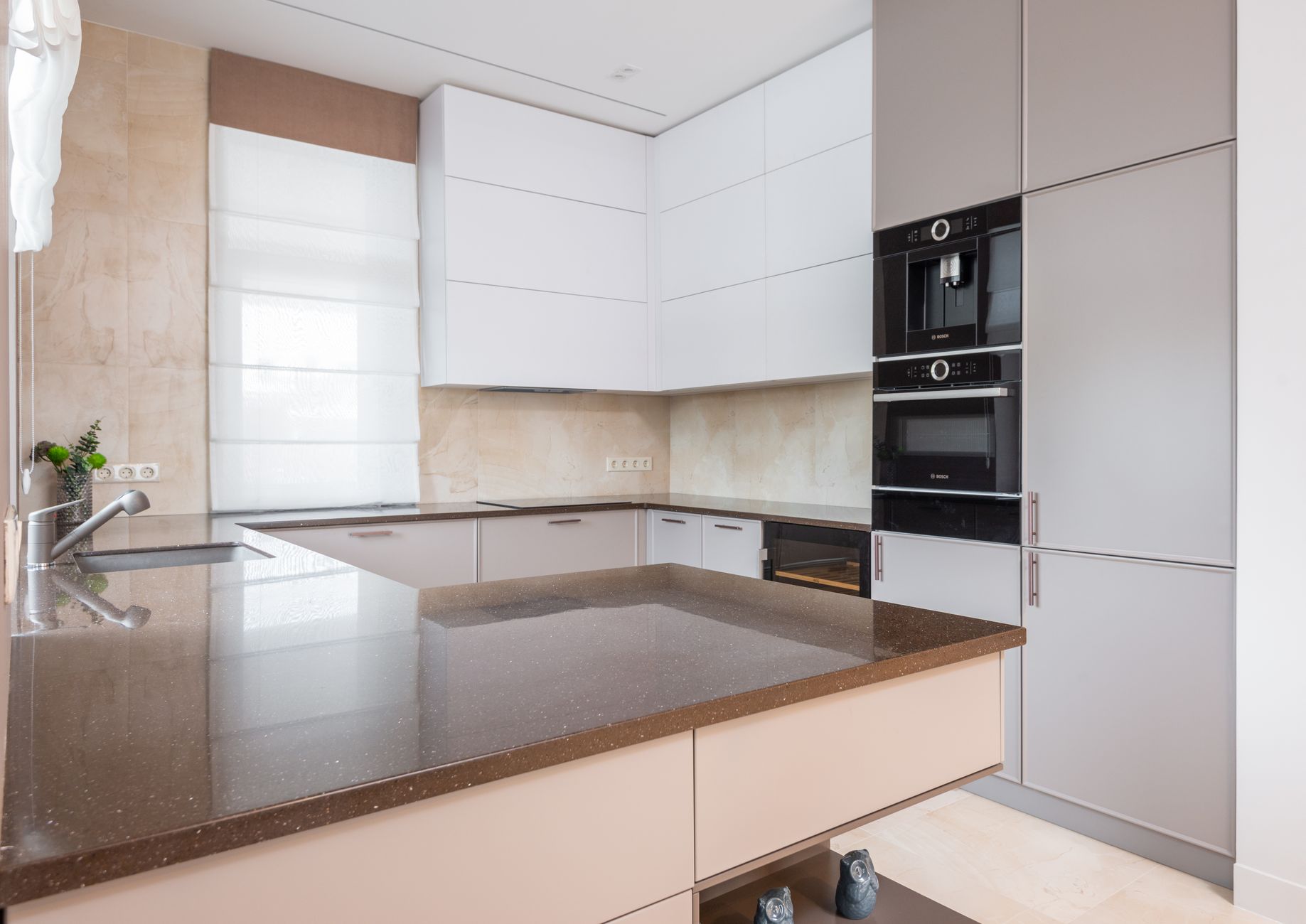
The sink is the hardest working square foot in any kitchen. It is wet for hours a day, it takes every hot pan and every dropped glass in the house, and it is the one place where a countertop stops being a surface and starts being a container.
The usual arrangement is an undermount bowl. A stainless, fireclay or composite sink is hung beneath the stone on clips and adhesive, and the machined edge of the cutout becomes the rim of the opening. It works, it has worked for decades, and it carries one permanent feature that nobody chooses and everybody lives with. There is a joint, a thin line of sealant running the whole way around the bowl where two different materials meet, and that line is the part of a kitchen that ages fastest.
An integrated sink is an attempt to delete that line. Instead of buying a bowl and hanging it, the fabricator builds one from the same material as the counter, so the deck, the rim and the inside of the basin are a single continuous surface in a single colour. It can be made from granite, quartzite, engineered quartz, solid surface or a porcelain slab, and that choice changes nearly everything about how it is built and how it behaves in year five. These are trade notes on how the box is made, why the bottom cannot be flat, where it chips, and what can honestly be repaired.
Two unrelated products are sold under one word
Establish which of the two you are being quoted, because the word covers both.
A fabricated box. Five pieces of your countertop material are cut, mitred and bonded into an open topped box, which is then bonded under the deck. This is the one that exists in stone, quartz and porcelain, and it is what the rest of this article is about.
A moulded bowl in solid surface. Acrylic solid surface can be thermoformed and then seamed with the same material, so the joint is chemically identical to the parts either side of it. When people say seamless and mean it literally, this is the material they mean.
The distinction decides what happens when something goes wrong. A moulded solid surface bowl can be sanded and refinished by hand almost indefinitely. A fabricated stone box cannot.
How a fabricated box is actually made
The box is five pieces: four walls and a base. Each wall meets the base and its neighbours on a forty five degree mitre, so at every corner the finished face runs right to the outside of the joint and no cut edge is looking at you. On a printed or glazed material that mitre is not a preference, it is the only way to keep the pattern on the inside of the bowl instead of a band of unrelated body colour.
Those cuts have to be exact along their whole length. A mitre that drifts half a degree over eighteen inches leaves a corner tight at one end and open at the other, and unlike a mitre on the end of an island, this one is going to be full of water.
The pieces are assembled in a jig, closed over a bead of colour matched adhesive and clamped until cured. Better shops rout a groove into the mating faces first and bed a reinforcing rod across the joint, particularly along the base joints, which carry a full basin plus whatever is soaking in it. The interior is then polished through the same grit sequence as the face.
The box is bonded under the deck around the opening last. Nothing moves until that adhesive is hard, which is why an integrated sink adds days to a fabrication schedule rather than hours.
The inside corners, and the argument about coving
A hard mitred corner inside a basin is a sharp internal angle, and it is where grease, coffee grounds and limescale collect while a cloth glides past. Many shops run a small cove into the internal corners and the base joints after assembly. A crisp corner photographs better and cleans worse. Ask which you are getting.
The bottom cannot be flat, and this is where most of them fail
This is the detail that separates an integrated sink that is a pleasure from one that is a daily annoyance, and it is almost never raised in a showroom.
A manufactured stainless bowl arrives with its floor pressed into a gentle fall toward the drain, and you never notice, because you have never seen it not work. A fabricated box is built from flat panels, and a flat panel stays flat unless somebody deliberately makes it otherwise. Build a box on a level base and after every wash you are left with a film of standing water that drains by evaporation rather than by gravity.
In a region with water this hard, that film is not just a puddle. It is a thin layer of dissolved mineral drying in place every single day, so the basin floor develops a dull haze sitting on top of the finish. On engineered quartz it takes a deliberate descaling to shift, and the acids that shift it fastest are the ones you should not be putting on a resin bound surface.
There are three honest ways to give the base a fall, and a shop should be able to name the one it uses.
Mill the base. On thicker material the base panel is machined so it thins toward the drain, giving a continuous fall in the finished floor. The cleanest result and the most machine time, and it is unavailable in thin material, because on a twelve millimetre panel there is nothing to remove.
Set the base on a tilt. The panel is bonded at a slight angle to the horizontal with the mitres cut to suit. It works well, and it has to be planned before anything is cut, because every wall height changes.
Use a ramp. The base is built as a plane falling from the front of the basin toward the back, where the drain sits in the lowest corner or feeds a channel along the back wall. A slot drain is the tidiest version: a narrow linear opening at the rear, with the whole floor sloping to it, so there is no round flange in the middle of the bowl to work around. Slot drains want a specific drain assembly, so the plumbing is settled at the same moment as the fabrication.
The fall involved is small, on the order of an eighth of an inch across the basin, sometimes a quarter. You cannot see it. You find out whether it is there by running the tap, shutting it off and coming back two minutes later.
Joints, adhesive and the thing that is always wet
Every joint in this box spends part of every day underwater and the rest of it damp, which is a harder service condition than any other joint in the kitchen.
Colour matched polyester cures fast and sands beautifully, which is why shops like it for seams and edges. Epoxies are slower and hold up better against constant moisture and the pH swings of detergent and descaler, so for a sink box the extra cure time is worth it.
The joint has to be filled, not merely closed. A tight dry joint with a whisker of adhesive in it wicks water into the gap, and a failing one gives warning in order: a fine dark line appears along a base corner, the line widens, then the cabinet floor underneath shows a damp patch. If you see the dark line, the sink is telling you something while it is still cheap to hear.
Silicone has no structural role inside a well made box. A shop proposing a bead of it along the internal corners as the waterproofing is building a tiled shower, not a sink, and that bead will discolour on exactly the schedule the undermount joint would have.
The rim, chipping, and what can honestly be repaired
The rim is the top edge of the basin wall where it meets the opening in the deck, and on a mitred box it starts life as a feathered arris of brittle material. Left sharp it is a chip waiting for its first cast iron pan. Every competent shop takes a small ease off it, barely visible and clearly felt with a fingertip, and on thin material you should ask for it by name.
When a chip happens, repairability is decided entirely by the material. Granite and quartzite take a tinted resin fill, dressed back and polished, and on a busy pattern the result is hard to find. Engineered quartz repairs acceptably on a patterned colour and poorly on a plain one, because a solid white basin shows a filled chip as a slightly different white forever. Porcelain is the hardest case: if the sheet is glazed rather than through body, a chip exposes a body of unrelated colour, and no filler reproduces a printed vein convincingly.
What cannot be repaired in place, in any material, is a crack that has started at an internal corner and run, or a base joint that has genuinely let go. Sometimes a base can be re-bonded from beneath if the cabinet gives access. Often the honest answer is that the basin is part of the counter piece, and replacing it means replacing that piece, with a new seam where there was not one before. That asymmetry is the real cost of the detail.
Against an undermount steel bowl, in daily use
Steel wins on several counts and it is not close. It costs a fraction as much, it is effectively immune to chipping, and it is kinder to dropped glassware because the panel flexes where a stone basin does not. And when a steel bowl is finally ruined it is a component: it comes out and a new one goes in without touching the stone.
The integrated box wins on the one thing it was built to win on. No bead of sealant at the deck, no clip line, no lip, no material transition, so water and crumbs sweep straight off the counter into the basin with nothing to catch on. The sensible compromise is to put it where appearance matters and abuse does not, a bar sink, a vanity, an island prep bowl, and to put a deep stainless bowl with proper support under it where the pans and the evening washing up actually happen.
One footnote that catches people out. A fabricated basin has no threaded boss for the drain, so the flange seats directly on the material, and plumber’s putty will stain porous natural stone around the opening. A neutral cure silicone is the correct bedding, and the drain assembly wants settling with the plumber before the box is built.
Before you commit, ask to see one the shop has built, fill it, pull the plug and stand there for two minutes. Where the water goes, and what is left behind when it has gone, tells you more about that fabricator than any photograph will.
Need help in Riverside?
Call (951) 702-1038